Where to Eat in Roppongi and Azabu
Updated 10 October 2026
This is an early list from Supper Social, opening for diner votes, and positions cannot be bought. Know two of these? Pick one.
See the full list: Restaurants in Azabu and Roppongi
Decide what the meal is for first. The address follows. The area is thick with Michelin stars, and a lot of them are hard to find, behind a plain door in Nishiazabu or a lift in a new tower. The sections below run by occasion: the big celebration, the counter you need an introduction for, wagyu, temple cooking, and old Tokyo eel and tonkatsu.
The once a year meal
Myoujyaku is Hidetoshi Nakamura's basement in Nishiazabu, where water and sea salt do most of the work and seasoning is kept to a minimum so each ingredient leads. The main counter seats eight. Three Michelin stars for Japanese cooking built on harmony and restraint. Nothing is added for show, which makes the seats easy to want and hard to get.
Sazenka is where Tomoya Kawada cooks what he calls tea Zen Chinese: Chinese technique applied to seasonal Japanese ingredients, from spring rolls to Sichuan stir fries. The idea behind it is wakon kansai, Japanese spirit with Chinese learning. Three Michelin stars in Minamiazabu, in a hushed room where precision is the point.
L'Effervescence runs on ichiza konryu, the tea ceremony ideal of host and guest sharing one gathering. Shinobu Namae's French menu in Nishiazabu moves from the signature Artisanal Vegetables to a risotto inspired by chakaiseki rice, and closes with a bowl of weak matcha. Three Michelin stars, with tea as the spine of the whole thing.
Kanda has a house line from Hiroyuki Kanda: subtle flavour is true flavour. His counter at Toranomon Hills Residential Tower proves it course by course, and his Tokushima roots show throughout, from the indigo noren at the door to fish from Naruto and Awa beef. Three Michelin stars, for diners who prefer whispers to fireworks.
Florilège moved to Azabudai Hills, and Hiroyasu Kawate built the new room around a single long table facing the open kitchen, served table d'hôte style. The cooking is French at root, with plant based and vegetarian mains put front and centre, and holds two Michelin stars. You come to watch the brigade as much as to eat.
Crony faces a park in Higashiazabu through glass walls and opens its menu with tea, a nod to a name meaning friends who drink tea together. Michihiro Haruta cooks contemporary French food to two Michelin stars, while owner and sommelier Kazutaka Ozawa keeps a cellar of more than 2,000 references, heavy on Champagne and Burgundy. The tea is a warm up.
The counter you need an introduction for
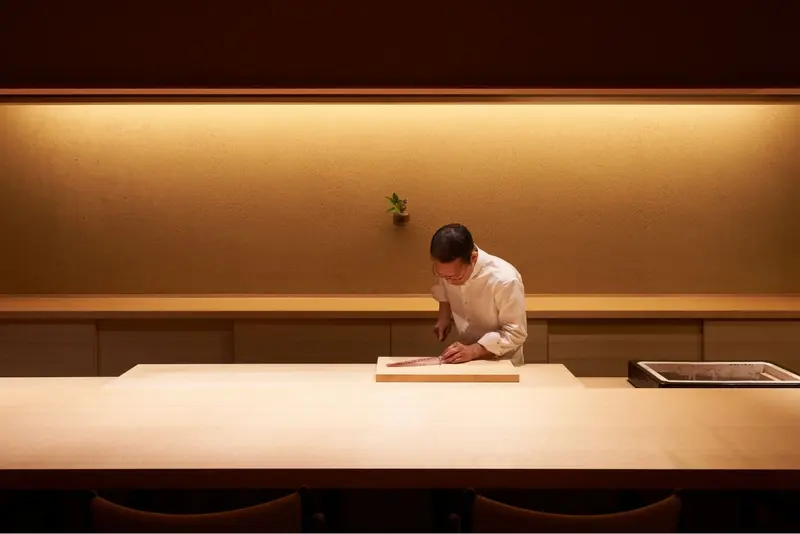
Saito is Takashi Saito's pale hinoki counter on the ground floor of Ark Hills South Tower in Roppongi, with room for about ten. Booking is by introduction, so most diners arrive as a regular's guest. What they find is sushi cut and shaped in front of them with no distractions. If you know a regular, be nice to them.
Wagyu, two ways
Yoroniku opened its third branch on the third floor of Azabudai Hills Tower Plaza, and added the brand's first fully private rooms, some looking onto greenery. The wagyu course runs like meat kaiseki: thin chateaubriand grilled rare, the house silk loin, a chateaubriand katsu sando and truffle sukiyaki with whipped yolk. Book the room if the conversation matters.
Yakiniku Jumbo Shirokane sits in Shirokane, a short ride south and a little outside the area, and it is worth the ride for Nohara yaki: hand cut A5 wagyu sirloin in the house tare, flashed on the grill and dipped in raw egg yolk. Order superior tongue, harami and zabuton alongside, and ask in advance for the filet rice.
Temple cooking, and plant forward plates
Sougo is Daisuke Nomura's shojin ryori restaurant on the third floor of the Roppongi Green Building. He cooked at Daigo before this, and his take on Buddhist temple cooking, meat free by design, is modern and calm. Vegan guests are catered for; give the kitchen two days' notice of dietary requests.
Daigo has been cooking shojin ryori since the restaurant stood in the grounds of Seishoji Temple. It now occupies sukiya style rooms in Forest Tower in Atago, where the fourth generation owner keeps the tradition and one Michelin star. One caveat matters: the restaurant says some dishes use a little bonito flake and egg, so this is not strictly vegetarian.
For plant based mains in a French key, Florilège is the other address to know.
Old Tokyo, lower stakes
Nodaiwa Azabu Iikura Honten has been in the eel business since the Edo shogunate. Fifth generation proprietor Kanejiro Kanemoto still steams the eel to drain its fat before grilling it plain, as shirayaki, or glazed in sauce, as kabayaki. One Michelin star, and unagi as the city once ate it.
Butagumi gives pork the treatment a wine list gives grapes. In a traditional house in Nishiazabu, the tonkatsu menu names its breeds, from Kagoshima kurobuta to Tokyo X and Okinawa's Nakijin Agu, with loin and fillet for each. It sits on our $$ tier, a step below the rest of this guide, and it makes an easy argument for ordering two.
Two Azabu tables, one tap. Which would you go back to? Vote
Nishiazabu or the towers?
Half of this area hides in old streets and half lives in new towers. Here is which is which, from each venue's address.
- Nishiazabu: Myoujyaku, L'Effervescence, Butagumi
- Minamiazabu: Sazenka
- Higashiazabu: Crony, Nodaiwa Azabu Iikura Honten
- Azabudai Hills: Florilège, Yoroniku
- Toranomon Hills Residential Tower: Kanda
- Forest Tower, Atago: Daigo
- Ark Hills South Tower, Roppongi: Saito
- Roppongi Green Building: Sougo
- Shirokane, just outside: Yakiniku Jumbo Shirokane
How this list works
It is an early editorial list, built from our own research, and it will be reordered as diner votes come in. Positions cannot be bought. More on how the list works.
Keep going: the Azabu and Roppongi area page, Japanese restaurants in Azabu and Roppongi, fine dining in Azabu and Roppongi, the Azabu and Roppongi guide, Tokyo Restaurants Worth Knowing, across town in Where to Eat in Ginza, and the rest of Tokyo.
This is an early list, opening for diner votes, and positions cannot be bought. Pick between two and help set the order: vote here.
Questions
- Where can vegans eat in Roppongi?
- Sougo, in the Roppongi Green Building, cooks shojin ryori, Buddhist temple cooking that is meat free by design, and caters for vegan guests with two days' notice of dietary requests. Daigo in Atago also cooks temple food, but says some dishes use a little bonito flake and egg.
- Can I book Saito?
- Booking at Saito is by introduction, so most diners arrive as the guest of a regular. We do not know of another route.
- Where can I get a private room for a meal in Azabu?
- Yoroniku at Azabudai Hills has the brand's first fully private rooms for its wagyu course, and Daigo in Atago serves its temple cooking in sukiya style rooms.
- Which restaurants are in Azabudai Hills?
- Florilège, with its long table facing the open kitchen and two Michelin stars, and Yoroniku, with its wagyu course and private rooms.
- How is this list put together?
- It is an early editorial list, built from our own research, and it will be reordered as diner votes come in. Positions cannot be bought.
Places in this guide
- MyoujyakuAzabu & Roppongi · Japanese
- SazenkaAzabu & Roppongi · Asian
- L’EffervescenceAzabu & Roppongi · Fine Dining
- KandaAzabu & Roppongi · Japanese
- FlorilègeAzabu & Roppongi · Fine Dining
- CronyAzabu & Roppongi · Fine Dining
- SaitoAzabu & Roppongi · Japanese
- YoronikuAzabu & Roppongi · Japanese
- Yakiniku Jumbo ShirokaneAzabu & Roppongi · Japanese
- SougoAzabu & Roppongi · Japanese
- DaigoAzabu & Roppongi · Japanese
- Nodaiwa Azabu Iikura HontenAzabu & Roppongi · Japanese
- ButagumiAzabu & Roppongi · Japanese
Missed one?
Put it in the ring. If it's good, diners will rank it.
Vote on places in this guide